





Statement of Educational Effectiveness
In keeping with ATS accreditation requirements, MDC publishes this Statement of Educational Effectiveness to give students, alumni, churches, and the wider public a clear picture of how well our programs are fulfilling their goals.

McMaster Divinity College is accredited by the Commission on Accrediting of the Association of Theological Schools (ATS). ATS was established in 1936 as the official accrediting body of professional graduate theological institutions in Canada and the United States. The Association requires oversight of member institutions through periodic assessments, measurements of educational effectiveness, and annual reports; it also provides resources through publications, training events, and general meetings.
The Commission contact information is:
The Commission on Accrediting of the Association of Theological Schools
10 Summit Park Drive
Pittsburgh, PA 15275, USA
Telephone: 412.788.6505
Fax: 412.788.6510
Website: www.ats.edu
McMaster Divinity College has been a full member of ATS since 1954 and was granted the maximum 10-year accreditation standing at the last review in 2019. In keeping with ATS accreditation requirements, MDC publishes this Statement of Educational Effectiveness to give students, alumni, churches, and the wider public a clear picture of how well our programs are fulfilling their goals.
Degree Programs Covered
All of the degree programs offered by McMaster Divinity College are accredited by ATS, and the following degree programs are approved.
- Doctor of Philosophy in Christian Theology (PhD)
- Doctor of Practical Theology (DPT)
- Master of Arts in Christian Studies (MA)
- Master of Divinity (MDiv)
- Master of Arts in Theology and Ministry (MA)
- Master of Arts in Counselling and Spiritual Care (MA)
- Master of Theological Studies (MTS) (discontinued)
How MDC Assesses Effectiveness
McMaster Divinity College evaluates the effectiveness of its programs through a cycle of assessment that runs throughout the academic year. Students, faculty, administration, and board members all take part, and the results are used to improve our programs and inform institutional planning.
Course and Curriculum Review
- Course evaluations. Students complete an evaluation for every course offered. Relevant faculty and administration analyze the results.
- Syllabus review. Each year, course syllabi are reviewed by both the instructor and administration (the Vice-President Academic and the President) before they are posted and shared with students.
Student Formation and Progress
- Ministry Reflection Seminar assessments. Students complete assessment forms three times a year, which relevant faculty and administration collect and analyze.
- Doctoral progress reports. Each spring, doctoral students and their supervisory team complete a Program Progress Checklist, which records the previous year’s achievements and sets objectives for the next year.
Graduate Outcomes
- Program Outcome Assessment Survey. Each year, graduates complete this survey. All faculty and administration review the collated results at the first faculty meeting of the following academic year.
Institutional Review and Planning
- Institutional Assessment Committee. Each year, a committee of faculty, administrators, and board members analyzes the data from these measures and evaluates MDC’s institutional effectiveness using ATS standards of assessment.
- Strategic planning. The data and recommendations from these measures shape MDC’s institutional strategic plan, which is updated yearly.
Student Profile and Enrollment Trends
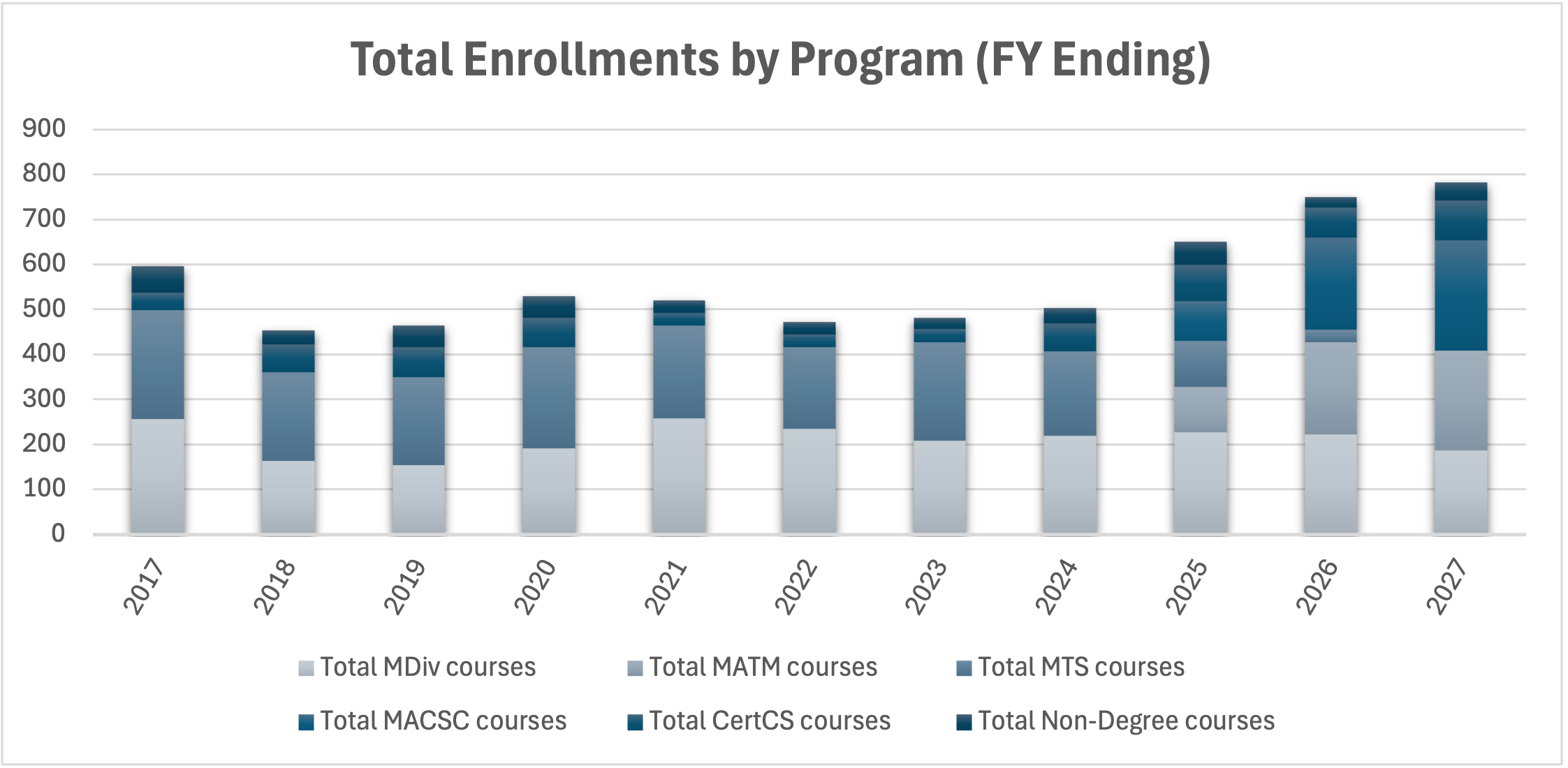
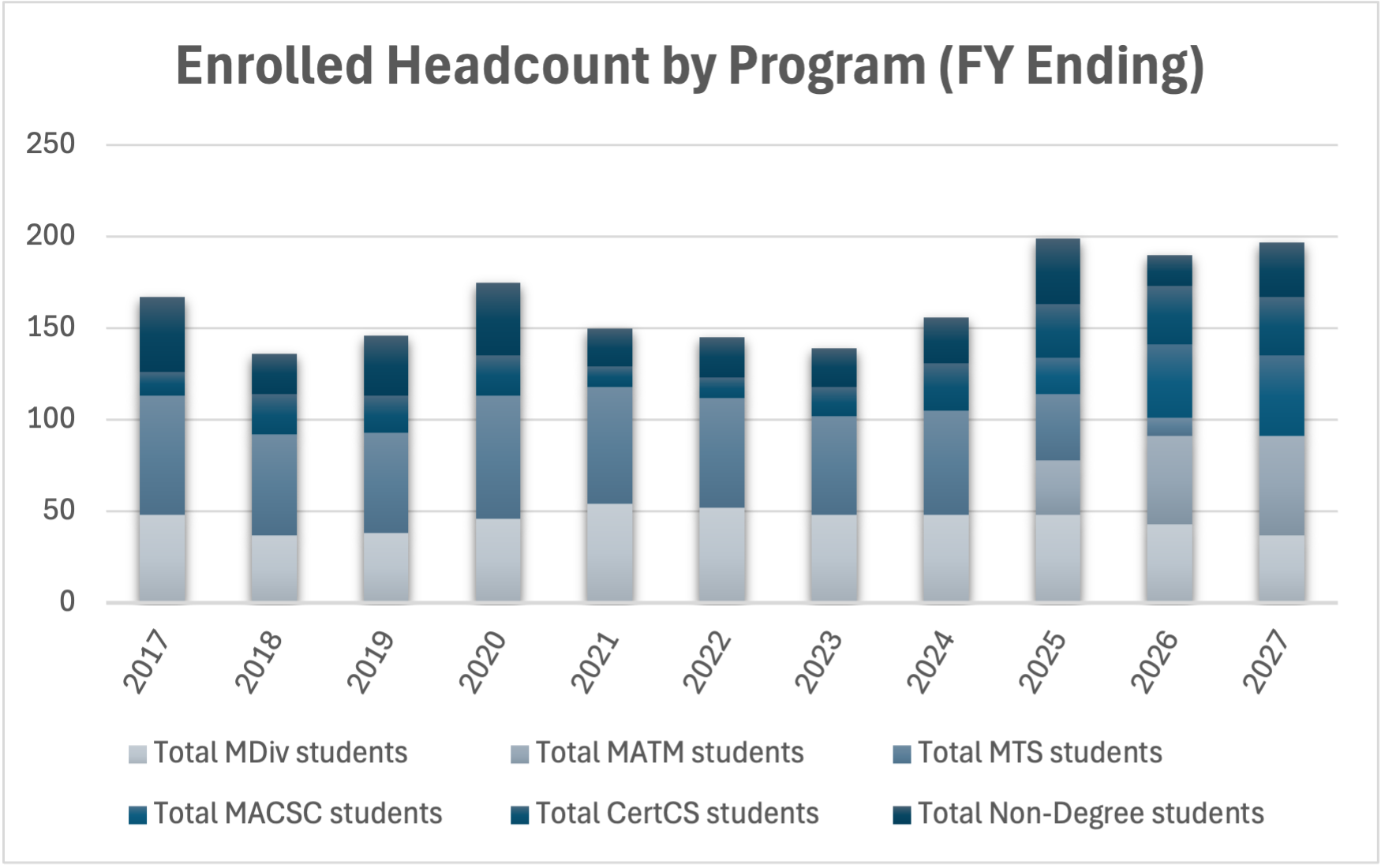
MDC’s professional degree programs (MDiv, MACSC, MATM, and CertCS) have experienced steady enrollment growth over the past five years. While some students pursue their studies full time, many enroll part time, continuing to serve in ministry and other vocational roles alongside their academic studies. Several newer programs, including the MACSC and DPT, have demonstrated particularly strong growth. In response to the diverse needs of our students, MDC has also expanded its delivery formats to include livestream classrooms, which bring together in-person and online students in a shared, interactive learning environment, as well as both synchronous and asynchronous online courses.
Evidence of Educational Outcomes
Over the past five years, the most commonly cited areas where doctoral students indicate progress and growth are:
- Competent knowledge and understanding of the current research methodologies and interests of my discipline (8.7/10)
- Familiarity with the professional societies, publications and conferences relevant to my discipline (8.7/10)
- Attaining an appropriate level of expertise in my discipline and area of research interest (8.8/10)
In feedback from surveys, PhD students say they achieved their goal of learning to research better and finished well equipped for scholarship, the academy and the church. DPT students say they apply their research in sermons, articles, speeches and teaching.
Over the past five years, the most commonly cited areas where professional degree students (MDiv, MTS, MATM) most often indicate progress are:
- Able to reflect theologically, in dialogue with appropriate biblical and historical resources
- Ability to teach well (8.2/10)
- Have a clear understanding of various pastoral leadership styles, and able to model a style suited to my gifts and calling (8.3/10)
- Solid understanding of different forms of Christian spirituality and spiritual disciplines (8.2/10)
In feedback from surveys students credit professors for recognizing gifts they hadn’t seen in themselves, and say the program helped them lead with grace and understand leadership in a Canadian multicultural context.
If you have questions regarding accreditation, institutional effectiveness, or educational outcomes, please contact our Vice President Academic.